My Battle With Graves Disease part 11: battle lost, war not over.

As mentioned in my previous blog I started noticing some symptoms related to Graves disease (hard pumping a bit harder, not sleeping to well), but I thought it was more due to stress and a bit of time off would be good. However, having gotten 2 more measurements, the results were not good. As in, Graves disease is rearing it’s ugly head again. The results were not that extreme as previously (see below), but bad enough so that after meeting with the doctor, I started with medication again.

This was a huge setback and very frustrating. Because, why did I put all this effort in eating healthy, especially gluten and cowdairy free, taking supplements, etc… Was it all really a waste of effort? All the money you put into to it and this is the result… Unfortunalty you can’t A/B test yourself, because it might have been worse if I didn’t do all those things.

Another aspect is the COVID-19 vaccination. Before the summer all my bloodvalues were good and seem to get stronger. Then I got my 2 vaccinations during the summer, and a few weeks later i started feeling some symptoms and the bloodvalues have been declining ever since. So is that a direct result? The doctor couldn’t really tell, they just don’t know, but acknowledged that it is a possibility since the vaccine trains the auto-immune system so it could have been a trigger. It could also be stress related, but it’s just too easy to blame something without actually knowing.

I was reluctant to meet with the doctor, not just because of the possible ‘I told you so’ but also because I still don’t want to take iodine treatment which destroyes part of your thyroid through radioactivity. Although it’s overall quite safe, it still feels weird to 1) take a radioactive pill to 2) destroy a good organ, because it’s the auto-immune system that’s acting up, not the thyroid. My hesitancy was supported by this research with the following summary:

Overall, patients with treated Graves’ disease had worse thyroid-related quality of life scores than the general population. Among the three treatment groups, patients who received radioactive iodine therapy had worse thyroid-specific quality of life scores than patients treated with antithyroid drugs or surgery, as measured by ThyPRO. The radioactive iodine therapy group had worse scores for goiter symptoms, hyperthyroid symptoms, tiredness, anxiety, depression, emotional susceptibility, impaired social life, impaired daily life, and impaired sex life than the antithyroid drug and surgery groups. In addition, the radioactive iodine therapy group had worse scores in hypothyroid symptoms, eye symptoms, and appearance than the antithyroid drug group. A similar pattern was found in general quality of life measures as assessed with the SF-36 questionnaire, with worse scores in radioactive iodine therapy group compared to the antithyroid drug or surgery groups.

So not a very attractive thing to look forward to. However, when meeting the doctor things went quite okay. She was understanding, acknowledged the posssibility that the vaccination could have triggered things and again, that they simply don’t know what the cause is of Graves. When I said I don’t want to do the rediation therapy, she explained the potential side-effects of the medication, which are rare (bonemarrow not making enough white bloodcells) and went along with a more extended titration therapy (reducing the amount of medicine to a minimum for a longer time).

She did mention that eventually the thyriod will ware out, sooner than with ‘normal’ people and then you would end up with hypothyroidism, which also requires medicine. But when this happens, differs per person. The radioation therapy ‘simply’ makes this moment come sooner. But for now, it’s taking a higher dose for 2 weeks and after than reduce it and see how my body reacts.

As you can image, a disappointing time and I have to deal with this mentally as well. However, I tend to look on the positive side, without the diet and supplements I think I would be worse off. Because i’m in pretty good shape for a 46 person…if I say so myself.

So I’ll write an update in a few weeks/months about how things went, for now i’m trying to come to terms with what feels like a ‘failure’, but is likely just a genetic pre-disposition to this type of auto-immune disease.

My Battle with Graves Disease, part 10: here we go again ?!

The months before my vacation in August were hectic and stressfull both at work and at home. As i mentioned in my previous blog we started looking for a house and i was looking for a new job, which i took. So i was really tired and very much looking forward to a vacation.

I also did not sleep well that much and during the vacation, almost right after an intense workout a got sick for a few days, fever like symptoms . Following that i also started feeling certain symptoms again, like being nervous, lost a bit of weight, tight chest, etc… Normally i would ascribed that to stress but in my case it could also be something else. So right after i got back from vacation i thought i’d do a checkup (bloodtest) of my thyroid values just to make sure nothing was wrong.

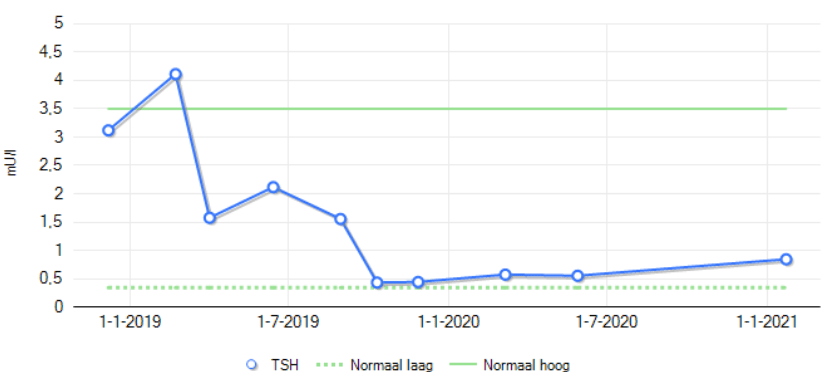
When i got the results my first thoughts were: “oh no, not again” and “was all this effort a waste of time and money?” Below are the results of TSH, FT4 and 1 extra check of the T3 requested by the doctor.

TSH results

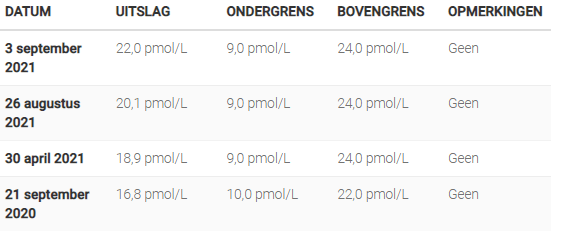
This what was scary, my TSH values were extremely low when i did the check on 26 august. The normal range is between 0,4 and 4.0. Although the FT4 (below) value was within range of 9-24 it was still rising compared to previous

FT4 results
T3 results

So i called the docter myself as i wanted to see what they said. Because the FT4 is still in the right range, there was no panic (on their side) but it was cause for concern. They wanted me to do another bloodtest including a T3 test. The results ( 3 september) were, at least for me, even more reason for concern as the TSH was even lower and the FT4 higher (but still within range). However because the T3 value was OK, the agreement was to do another bloodtest in 6 weeks.

I also called the orhtomoleculair doctor i was seeing and wanted his input. Although he wanted to see what the results were of the second test, he did adviced me to double the dosage for gypsywort as it seems to have a natural effect on thyroid hormones.

So quite a big scare and especially on the day i saw the results my body really started acting up, most likely the result of a psychological effect from seeing the results. However, in the days after the results i slowly started feeling better and better. I did take it a bit easy in my workouts and tried to go to bed earlier. But i am now at a point where i feel quite OK, (almost) none of the symptoms are present anymore so i’m quite interested in seeing the results in a few weeks.

Impact of Stress

My personally believe is that stress has a bigger effect on me, or at least my auto-immune system, than i thought. You can find lots of resources for this. And taking away the stress of my current job, choosing a new job, vacation is a big reason why i’m feeling ok now. Don’t know for sure how much the doubling of the gypsywort dosage contributed, but i’ll take it.

So next step is to see how i can incorporate more stress-reducing activities like simple breathing excersice and longer walks. Another aspect is sports and for me, sport is stress reducing. But it can also cause a lot of stress on the body, especially when doing Crossfit which is often high intensity. So i will also start reducing the intensity a bit by not going all-out all the time, which i already started doing a more of lately.

To summarize, a long period of stress is what likely got me even more stressfull when seeing the result, but reducing the stress is what likely contributed to feeling OK now. I’ll let you know if 6 weeks what the results are.

Choose Wisely…

Indiana Jones fans know this phrase by heart as Indy had to choose the ‘cup of life’ from an array of cups in the movie ‘Indiana Jones and the Last Crusade’. A great movie with a great cast. The phrase is currently top-of-mind as sometimes in life you’re given certain opportunities of which it’s not 100% sure upfront that it’s a good one. So I thought i’d write a blog to help me think about it. So what are my choices?

A new house

Currently in the Netherlands, and pretty much all over the world, prices of the housemarket is really high (and too high in my view). And although we just renovated our house (which we’ve had for 15 years) the last year we already had that feeling that we wanted something else. Something a bit more out of town, stand-alone house, own parkingspaces. So we had a 5 year plan……. However, when you start looking for something, the chances are that you’re going to find something.

And we did, a really nice house, quiet neighbourhood, with a bigger garden, stand-alone, own parkingspaces, etc… The price was not bad, and we had to consider that we will sell our house for way more than we’ve paid for. The conudrum that we face has to do with our kids. If we buy the house, it means moving half-way through the year to a new town and environment. Anyone with kids knows moving is already a burden, let alone half way a school year. So we really struggled with the choice to make an offer.

What we did in the end is ask for a later date so our kids could finish the year. We got a voice-mail from the realtor saying they would not accept the offer as-is, but were open to negotiate. Unfortunatly the realtor got sick so it’s now up in the air as to what they expect. We can’t afford more that the asking price so it’s now a waiting game. And dependent on the answer we again have to choose if we want to move forward.

A new job

I recently starting looking around seeing what kind of companies and jobs are out there which are interesting for me, mostely product owner/manager roles. I’ve worked at the biggest e-commerce company in the Netherlands and Belgiums as an architect and product manager/owner. And right away I found a few interesting ones. But I also found that >11 years working at my current company, especially as an architect, made me very expensive as a product owner/manager.

Last weeks i’ve been in contact, and basically applying for a job, with a company which is really cool and vibrant, with a small number of people (+/- 50 compared to 3000) in an e-commerce environment and a few familair faces. It sounds like a great opportunity. But then I got the offer, which basically comes down to a salary gap of 400€ a month, and less pension. Now it’s still a good salary and opportunity to grow, they have ‘unlimited’ vacation days, a really nice central office and 50/50 office/home work.

So what do you do? My current job is not bad and I can see myself staying there for a while but am I really happy there? Or is the corona pandemic causing me the ‘flee’ and make a poor decision too fast? Or is it a great oppotunity i disquise. Especially when we also have the new house possibly to look forward to much with also a higher mortgage.

Conclusion (or not)

I really have no idea, and i wish these 2 big choise wouldn’t come at the same time and have such an influence on eachother, but I have to choose soon. The new job won’t wait forever but we also probably won’t get a definitive answer really soon regarding the new house. And even if we did, it’s really hard to estimate what the new montly expenses will be. So it’s a ‘gut’-feeling vs a pragmatic/safe choise.

I am leaning towards taking the job although my salary will be quite less. However, I see opportunities in a small company growing rapidly, including salary. And I know salary isn’t everything, but when you also have a family, it weighs heavily. I’ll update this blog when choises have been made 🙂

My Battle With Graves Disease, part 9: check-up

In my last blog told about the fact that i was no longer under medical supervision and once again on my own. Hoping that the symptoms will not return and keeping up with my diet and lifestyle.

I still am a bit anxious because after the first time i was ‘fired’ i had a relapse about 1 1/2 year later. So now that i’m in my second ‘fireing’ for almost the same period it starting the gnaw at me, feeling like the sword of Damocles hovering over me.

When you are fired from medical supervision the statement is that you should do a bloodcheck (for THS and T4) every year through your local doctor. From my perspective this is not enough and i would say that you should be able to do it every 3 or 4 months. With once a year you are almost always too late to detect changes. Good thing is that with a little ‘white’-lie you can get more….so i did.

Checkup

The result of the bloodtest was encouraging:

  • TSH 1,21 mU/L
  • T4 18,9 pmol/L

Below is a table of my previous results so as you can see i was worried that (free) T4 value would be higher again, but it actually went down a little but. TSH is much better as it’s now more in the middle

Although it’s still early in the process and people have been known to go for longer periods without a relapse, i felt good about the results. It would seem that, but i can’t scientifically support that, my gluten- and cowdiary free diet combined with specific supplements is working for me. Even with the extra stress that comes with the corona-situation.

Magnesium (shortage)

What’s bothering me more is my struggle with is my magnesium levels (need to be between  0,7 en 1,0 mmol/liter and i’m structurally below that) and i have been taking various types of supplements but none seem to take. I measure this through bloodtests and although there’s some critisism as to the value of a bloodtest for magnesium, if you get enough bloodtest then you should be able to detect a pattern. My orthomoleculair doctor told me that some people just won’t absorb certain variants of magnesium and that it can take some figuring out what the right type is. Sure, but i’ve been at it for a few years now…so patience is running out.

Why am i worried about my magnesium? Well, because it’s important for a lot of things but for me my it’s important to help support a healthy sleeping pattern, auto-immune system, (as an athlete) support performance when working out and helps prevent cramps which i regularly have in my calfs.

So right now i’m on my fifth or sixth variant (there are quite some variants) which is a liquid form a Magnesium. I have a testresult coming up in a few weeks so hopefully i’ll get some good news. But seeing as i do get cramps in my calfs (and other places) quite often i’m not too hopefull. If you have any tips, let me know! But i’ll let you know what comes up including results from a second thyroid related bloodtest in a few months (already working on an excuse for that one).

Increasing My Mobility Part I: getting started and setting goals

After years of basketball, sprained ankles, torn ankle ligaments and office desk-jobs, my overall mobility isn’t that good. You probably feel jealous of your kids when they can sit in a deep squat for a long time. Even 400-pound sumowrestlers are more mobile than me. I had trouble even getting in a fairly deep squat not to mention getting up again.

This was especially frustrating during the more complex lifts in Crossfit, like overhead squats, pistol squats, snatch, etc.. I was usually strong enough to get weights overhead but then getting into a deep enough squat was difficult as i was bending forward and thus losing stability. To accomodate this a but i bought lifters (shoes with a elevated heel which allows you to go a bit deep) and this worked well, especially when you’re warm but you don’t wear lifters all the time and i don’t want to depend on them.

More over, during this corona pandemic, when you sit more behind/infront your laptop and can workout less (although outside group classes are possible again) you’re mobility deteriorates rapidly. When having good mobility is just so important in general. Just putting on a sock standing up can sometimes even be difficult. But i wanted to get more out of my crossfit workouts so i set myself a goal of increasing mobility in my ankles, hips, thorax, shoulders, everything.

Flexibility is defined as “the ability of a muscle or muscle groups to lengthen passively through a range of motion”, whereas mobility is the “ability of a joint to move actively through a range of motion”.

https://ssphysio.com.au/mobility-vs-flexibility/

I first started with some research and seeing if there were some good ‘paid’ options. There were quite some ’21-days’ options but i don’t believe that much in the ’21-days’ concept as it implies that you’re done after 21-days. More over, they started posting mobility WOD’s video’s at my crossfit box which were really good, inspiring and definitly frustrating when you can perform certain exercises.

Youtube is of course also good place to start but there is so much. After watching man videos i ended up using the following channels mostly:

There are some other sources i use to get some inspiration but after a while you get an idea of which exercises are important (the ones that everyone uses).

So i set out to spend 15-20 minutes at least 6 times a week on mobility mostly with ‘2-minute’ holds and some dynamic exercises. The 2 minutes is something that i kept hearing and after a bit of digging to find some scientific backing i found this quote:

Studies done at the cellular level, particularly on tensegrity and mechanotransduction, suggests that if we want to make actual physiological changes to tissue we need to be applying forces to our tissues for around two minutes or more.  

This two minute mark is determined as the average time cells begin to recognize the stresses being placed on a tissue.  So spending longer duration time in a particular position can help teach tissues to reorganize themselves, making long lasting changes over time.  As Dr. Andreo Spina frequently states, “Force is the language of cells.” 

https://www.perfectstridept.com/bloghome/2016/12/9/re-thinking-stretching

This also means that you have to put in the work and not expect magic to happen overnight. I worked on a deeper squat for while and only after a few weeks you could see a bit improvement.

But how do you measure your progress? Unfortunatly, i forgot to make a video of day 1 so that i could compare it to day 30/60. However i did a workout 2 days ago with the (Crossfit) benchmark ‘Helen’, 5 rounds of 400m running and 15 overhead squats with 43 Kg (rx), and that went very well. I could keep upright way more with the rx weight, and also keep balance and speed. So that felt like progress.

I’ll see if i feel like making a video or something but for me the test is to be able to sit in a deep squat very easily with a straight back and being able to push the knees out with my elbows. The goal after that is to be able to point your arms and fingers straight up in the deep squat but that’s a long way from happening. You got to start somewhere.

So i will keep doing my 6 days a week stretching routines with various stretches and see what works best. In 2 months i will post an update on my progress and, if succesful, the routines i used. But i can tell you now that it’s not about the exercises, but about the consistent work you put into it. Stay tuned.

Netflix Health Documentaries part II: Cowspiracy and Seaspiracy

In these corona times I thought it would be a good idea to follow up on my previous blog about netflixs’ health related documentaries. So below are two I’ve watched and my thoughts on them.

Cowspiracy

bol.com | Cowspiracy, Keegan Kuhn | 9781608878437 | Boeken

This documentary is from the same people as ‘what the health‘ but cowspiracy focuses on the relation between the environment, polution and the animal industry. As most people know and what the data shows is that animal-stock for food has one of the biggest impact on polution of soil and air and the destruction of natural habitat. Either directly by destroying forrest land or indirectly by polution through manour or the food needed to feed the animals, which again causes destruction of natural forrest and land.

As with ‘What the health’ this is a personal discovery story which includes the political entanglement between environmental protection agencies and the industry & politics from which they should protect us. It does not go into too much detail about health, but again it does point out the need (or lack of) for meat and nutrition. It’s not really needed and we can get most of the protein from plant based food with a much lower footprint.

Again, this documentary is very much oriented towards the US but in the Netherlands this topic is very actual and the reason why the past months their were a lot of protest from farmers. The documentary shows a few interviews with several people and it’s interesting (for lack of a better word) to see how they (from the environmental protection agencies) try to avoid answering very obvious questions.

Now i suppose there is always a nuance and i think the world can have an animal stock for food, but it drives the point home that it starts with human behaviour and education. The last few years these documentaries, scientific studies, vegan and vegetarian diets and meat-substitutes have already started a shift in how people approach meat (or dairyproducts). So a very interesting documentary, sometimes a bit slow, but this in some aspects is better than its better known brother ‘what the health’.

Seaspiracy

Yesterday I watched a sort of ‘sequal’ to cowspiracy but with the sea being the centerpoint: Seaspiracy. Now, if you’ve watched cowspiracy and stopped eating meat….this will definitely make you stop eating fish all together.

The documentary is well made but tries to fit in lots of viewpoints and takes on our troubled oceans which make it feel rushed at some points.

On the other hand, it gets the message across, we are killing our oceans all the way through and thus are killing our selves. I thought I knew quite a bit but lots of interesting facts came up:

  • Fish/whale/shark poop feeds the oceans
  • Algea and oceans in general take up way more co2 than all rainforests take together (sort of logical since it’s really vast)
  • The movement of fish and other creates through the oceans vertically, also contributes to how oceans behave and nutrients are distributed
  • Almost 50% of the plastic soup is made up of fishing gear, not plastic straws
  • Fish population can recover quite fast…if left alone
  • Overall there is 90% decline over the past decades of fish/shard/whale/dolphin population
  • The MSC label of fish is a huge joke since there is little oversight and in some cases people who went along as observers got ‘lost’
  • Entaglement between crime-syndicates, governments and the fishindustry is enourmous, they don’t care about future generations, they care about money.
  • Warming of the planet is not the only cause of coral-reefs dying, overfishing (and destructing by huge fishingnets) is more releated to coral-reefs dying because fish (and poop) is what keeps corals alive.

Now like cowspiracy it takes the worst of what’s going on in the world and focuses on main culprits doing damage like Europe, China, Japan and the US, since in those place, fishconsumption in combination with sheer number of consumers and money is enormous. What’s also, again, apparent is that organizations like MSC or others pretending to protect the ocean all seem to be sponsored by companies who have other interest and close ties to the fishing-industry. They try to put a lot of focus on consumer-plastic being the real problem, but apparently around half of the plastic in the ocean is fishing gear. But that’s not mentioned anywhere on any site, and when asked, people of those organizations often don’t have a good response.

There’s also a philisophical angel about eating fish, as we learn more and more about if fish feel pain. And the way fish are being caught, like killing animals for meat, is quite often inhumane.

Now it does not take enough time to also shine light on improvements some fishing-industries might have made and how for example fishquotas are a (half) attempt at preserving the fishpopulation. I don’t know enough about the topic but I know there is for example ‘pulse-fishing‘ and the site Medium also gives some insights into initiatives being taken and this site contains a paper with a set of proposals. So going to read up on that.

Now in the end hoping people will stop eating fish (which is sort of the conclusion of the documentary) is useless, in my view it’s about bundeling the power of technological innovation, educating (from kindergarden to cool documentaries) and government to bring about change and stop overfishing and destruction of ocean eco-systems. Not by saying ‘no’, but to help the fishing industry achieve a sustainable level, teaching people about the oceans and consequences of human influence on them (where is Jacques Cousteau when you need him), and coming up with alternatives for fish as food.

Will I stop eating fish? Probably not, but I will certainly try to eat less and be more aware of my consumption. The ocean has always had a mystical and romantic influence on me and my diving experience in Australia and Thailand were magical. Would be a real shame if my kids would not be able to enjoy that experience. The weird thing is that it’s solvable right now, but changing people and whole ‘fish-oriented’ cultures is a hard task, but documentaries like these hopefully will open some eyes!

My Corona Questions

Like everyone i’m fed up with the Corona crisis and want it to stop sooner that later. The primary challenge i have is getting good unbiased and/or emperical information about certain topics to form a good opinion.

Everyone seems to know the truth and what to do, but i always ask myself on what to they base that information. Good knowledgable people sometime come up with information and graphs which in hindsight don’t make sense. Social media is full of the ‘screaming wronged’ and almost by definition not a good source for information. So i thought i’d blog about 3 questions i have and see if i can get some answers.

The main reason for this is that i have now 2 statements

  • I don’t want a vaccination-passport
    • it will exclude people who should not be excluded
    • it will we used more widely that just ‘big events’, entering other countries for example.
    • i don’t need to show a vaccinationpassport for other possible diseases i’ve been vaccinated for, so why now?
    • i’m one of the last to get it, what happens untill that time?
    • once we have it, it’s very likely to stay (and misused), so without an exitstrategy…..
    • what about my kids (<12), won’t i be able to take them to large events anymore?
    • it seems like a beginning of the end
  • I’m not sure i want a vaccin, because the data shows that my age-group, if healthy, has almost no risk of dying. So why would i need it?
    • For myself: I have an auto-immune decease, so even the slightest chance of things going wrong, i try to avoid. Otherwise i’m perfectly healthy (i think) and have almost no chance of dying.
    • For others: sure, but the agegroup (in combination with know underlying illness) for whom it’s a possible danger is getting a vaccin. So if they have a vaccin and somewhere between 70-90% protection, then the healthcare system will get back to normal. Because that’s why we’re in a lockdown.

So with that in mind i have a few questions:

1. Is the coronavaccin safe?

In my opinion and what i’ve read from what i feel are reliable sources: yes.

There are a lot of folks out there who have spoken out against it and are reluctant. From the anti-vaxx groups to sceptics, from big-pharma haters to doctors and other medical experts, and just regular people who feel they don’t get told the entire things.

So i’ve been reading about what the vaccin actually does (one example: cdc), how long it stays in the body, etc.. Preferably from a combination of sources, like actual experts on vaccins and people who invented it. I do get the sceptisism because it’s quite a new (rNA) technology that’s being used (although in the making for a long time), but that doesn’t make it a bad technology. Actually it’s very promosing and hopefull for future outbreaks (which will occur).

Moreover, there are almost 400mln people who have been vaccinated, with different vaccins. If it really was bad for you than a lot more people would have died and even countries like China and Russia won’t be able to keep their population in check.

What you do get is a lot of news about people dying after they’ve gotten the vaccin which now even means that some countries stop giving people the AstraZenica vaccin. I found this site to be helpfull which investigated those deaths. And depending on your level of sceptisism, it’s often older people (>70) who have other health-issues as well and simply the ‘normal’ deathrate. Those people would have died anyway and it does not seem to be related.

Now bigpharma haters and conspiracy nuts will most likely not trust those numbers or sources, but then again, anything, no matter how realiable or emperical, won’t resonate with those people. So no use arguing there.

So why won’t you get the vaccin then if it’s safe?

Good question: same reason i don’t get the flu-shot, why would i need a vaccin against something that only affects me like a flu. Sure there is a risk, and if the vaccins started with the healthy population it would have gotten it. But that’s not what’s happening. And i have a firm believe that healthy food and living is protection enough against corona, maybe not from contracting it or even getting sick, but dying…..nope

2. Is corona no worse than the flu?

No it’s definitly worse, however, what you hear it’s 3-5 times more lethal than the flu. Which sounds bad, and it is, but you have to look at the group of people for which it is so lethal. According to the site i shared (worse):

COVID-19 patients with the highest risk of death included those aged 75 and older who also had chronic kidney disease or dementia, and Blacks who were obese, or who had diabetes or kidney disease.

So, although bad for those people which need to be protected because it’s definitly not always their fault (yes, even obesity is not always something just to be solved with eating less and more excercise), it most certainly does not apply to everyone. And that’s where politicians and newsoutlets play the ‘scare’-card to get people in line.

So excellent news that those people will get vaccinated, that is the only way out. But for most people, especially reasonably healthy, if they get it, it’s more like a heavy flu. Yes, there’s always a small fraction of young healthy people who are worse off with the virus, but to base your life on those numbers seems wrong.

3. Who can i trust for corona information?

Everyone looks at it from their perspective and interests so there is no 1 source which has the ‘truth’. I do recommend potholer 54, a medical journalist who does his research well and gets to the bottom of certain public (covid) ‘truths’.

What i also try to do is listen to both sides of the isle and then really look out for specific generic arguments, statements or graphs people use and always aks: what are they showing me, what are they actually saying, which sources to they quote.

Especially regarding the evening-curfew, there is no clear evidence anywhere that it works. I’ve seen someone use a graph with a small decline which they related to the curfew but someone else related it to the weather or another event which seems just a likely. And people were already not going out much at night during winter. But i understand the rationale behind it, most transmissions occur during personel visits so keeping that to a minimal should in theory work.

Same goes for facemasks, there is very little actual evidence from studies that it has a big impact. Sure, it’s not being tauted as THE solution but having a law in place that mandates wearing masks in indoor public places without any clear evidence is strange to say the least.

But the question nowadays is, who can i trust for anything anymore. Difficult, but i have some suggestions.

My suggestions

  • Don’t limit yourself to 1 source, at least use 2 different sources
  • Look at the data yourself, in the Netherlands I use: https://allecijfers.nl/nieuws/statistieken-over-het-corona-virus-en-covid19/ which tells me that although the numbers are up (which is a result of policy change), the percentage is down which is more telling.
  • Don’t just ingest information/opinions, be critical what people tell you
  • Discuss things with other people, they might come up with an angle you haven’t thought of (which possibly could change your opinion, so be carefull 🙂 )
  • Listen mostly to people who actually know something about the subject being discussed. A doctor is not a virologist is not an immunologist is not…..
  • As always, educate yourself and keep learning!

And coming back to my statements, they still stand although i’m less worries about the vaccin.

Talking to Strangers

A while ago i started reading Malcolm Gladwell’s book, Talking to Strangers and i was pleasantly surprised. It’s a really great storytelling book about how well you really (think you) know someone and goes into several fabulous (historical) stories of spies and people from different walks of live meeting eachother and what happens when we start judging people without context.

Afbeeldingsresultaat voor talking to strangers

One of the most interesting parts was the story of policing and why it is that in de U.S. the police pull over people for very minor things in the hope to catch bigger fish. Apparently it started as an experiment where the police in one city determined where most crime was committed and based on that started this strategy. This was succesfull in that crimes dropped and thus other cities started to notice.

That’s where it (somewhere) went wrong. Most cities just adopted the strategy all over the place in stead of focussing it in areas where most crime was committed. And that, for example, resulted in the heartbreaking story of a black woman being stopped by a white police officer where the former got shot and killed. While it’s very easy to blame the officer, in my opinion it’s the system in which the officer has to operate and what he has been taught is at fault. Of course using your own judgement still is important but i would not underestimate the training they recieve, that where the more dire the situation gets in their perspective the more they fall back on that training. But this story is about that having asked one or two more questions could have prevented this tragedy.

Applying thoughts to work

All in all it’s a very good book, with more great stories, although it doesn’t really come up with a concrete conclusion or advise. But it got me thinking about how well i know people that i, for example, work with. You talk to them on a daily basis but really getting to know and understand them is something i should do more often, otherwise they remain strangers.

And this is not to befriend them but to understand their background, motives and what drives them. For that you have to take time so one of the first things i did was spend at least half an hour a week with each teammember (team of 5) talking how things other than what’s currently on their plate. Still could be work related but more on a higher level like how they feel about the companies vision, or their ideas on the product that we are working on.

But also about personal stuff which really helps me in understanding people better. It’s not always easy because people don’t always feel comfortable talking about those things, so i usually open up a bit about myself. More over, i work at an e-commerce company (bol.com) where i work with software engineers, which are overall a special kind of breed, mostly with a hint of autistic tendencies and not always good at softskills. Luckily my team is quite good at being honest and open, but also sometimes without a filter. But once you get to know a bit better and understand them it really helps in the relationship and building a team.

Applying thoughts to personal life

After reading the book it also got me thinking about certain stories from my personal life. For example, one couple seemed very happy on the outside and although they were struck by the death of their unborn child, seemed very strong. But a while later, after they had moved, i got a call from my friend and wanted to talk. To my surprise he confessed to have cheated on his wife several times and that they were having struggles. Now, from the outside it seemed nothing was wrong, but we really didn’t know them for real i guess. Although this is always a hard to thing find out. The good thing is that they are still together.

I also have the same feeling about my father, although he cared for us very much and was always there, he never shared much about his youth or upbringing. Sometimes a few fragments here and there. I guess both my parents were like that, never being able to share or help us with emotions or tell stories, which reflects a lot on myself. So altough they were my parents they were also in some sense strangers to me because i never knew what they really felt and what motivated them.

Moving forward

Now i won’t do a deep dive with everyone i meet but i think the most important part is to keep an open mind. It’s very easy to draw conclusions. For example, when you see a young man with a middle-eastern complexion in an expensive car, you think: drugdealer (or something like that), but when you see a white kid in that same car you think: borrowing daddy’s car? Most likely it’s nothing like that. I guess being bombarded with (social) media opinions, bits&bites and screaming headlines makes it hard to keep an open mind.

Even my son, 11 years, already has a certain mindset towards certain types of people because that’s what the news shows him and what he hears in school and from people. And i have to keep telling him that certain behaviour or look doesn’t imply a bad thing, just something different. Unfortunalty certain people keep proving stereotypes right which makes my job as parent even harder.

For me it’s clear that you have to really talk to people to understand them and be respectfull (which can be quite hard) but that something people will remain strangers, no matter how close you are with them.

My Battle With Graves Disease, part 8: you’re fired!

It has been about 18 months since i stopped taking medicine for the second time due to Graves disease flaring up. It was also time for potentially my last call/visit (again) with the docter depending on the latest bloodtest. But also an uncertain feeling popping up.

The call

Since we are still in a lockdown a visit to the hospital was switched to a phonecall which i got on a tuesday morning. So, not unexpected, the results were good. Otherwise i would have noticed something by now (i hope). The call was short and ended with the fact that she would now transfer care to my local doctor. Which basically meant that i was ‘fired’ from her care.

I did ask about numbers and percentages for cases like mine, see said she didn’t have a lot of numbers but said that cases like mine still had a high percentage of coming back. And even if not, she mentioned that my thyroid would eventually ‘deplete’ and start going into hypothyroidsm. But when is uncertain.

The procedure now is that i have to do a bloodtest once a year for a checkup, which i have to schedule myself. Or, if think i have certain symptoms, do a bloodtest then.

The results

Above you can see the latest results, they are both within the boundaries of a goodworking thyroid. However when i look at the trend for the T4 (graph below) i do have some concerns since it’s an upward trend.

I’m less concerned with the TSH values since they are low in the bandwidth.

Hairloss on shins and calfs

A thing i noticed is that i am losing hair on the outside of my shins and calfs on both legs. A search on the internet resulted in a few hits but this report caught my eye which is named ‘anterolateral leg alopecia’, a form of hairloss on the legs which might related to the auto-immune system. So this is something to keep an eye on. I had it before but then it grew back (slowly) but now it’s receding again.

Now what?

I have ambiguous feelings, although it feels good to have been fired from care, the fact that the numbers are showing an increase and seeing how the previous ‘episode’ went takes me in uncertain territory.

Regarding the numbers, of course i would ideally have more testresults over a longer period to see about the trend. So my idea is not get tested once a year but at least 3 times a year. Especially since i was too late the second time.

Do i have a better feeling about it that last time? Yes, i am more optimistic because i’ve also change my diet to glutenfree and cowdairyfree (i do eat a bit of goat/sheep cheese now and then) since then. Also due to the changes in supplements, see this blog at the bottom (although i’ve stopped taking Q10) and adding gypsywort which is a plant that has supposed thyroid supporting capabilities.

The trick is to at least see how the next half year goes, since that was when it went wrong last time. So hopefully i can give a positive update before the summer. But after that…..we’ll see.

Teaching Crossfit during COVID-19

In my previous blog i wrote a bit about my learning experience of starting as a crossfit coach. During these times i’m fortunate that the box i work out at is open as well as the box that i teach at. So i wanted to share how that experience has been.

Start of the pandemic

When the pandemic started, everyone and everything had to shut down. Including gyms. This was (and still is) hard on small businesses where there is usually not a whole lot of savings to endure a long period. So it was for our crossfit box but it was good to see that our community still paying their monthly fee, even though they couldn’t do anything.

So quickly our box came up with 2 solutions which were really appreciated

  1. Lending equipment: from barbells and plats to rowingmachines. Like a library you could pick a few items to take home and return them the next week. Everyone took advantage of this and really took care of stuff
  2. Remote video-WOD’s: which were ok, mostly bodyweight but not a whole lot of interest.

All in all we could remain busy. The box where i teach had to close down entirely and were in more trouble because they mostly rely on income from brazilian jiu jitsu, kickboxing, etc… But because they just started crossfit and did not have a large crossfit community yet, that had to shutdown completely and could not provide an alternative.

Limited restart

Then before the summer the rules started changing which meant we could train outdoors. Luckily this was in the summer and it was good fun. However moving equiment out of the box to a small cemented area (and back) was not ideal, but great to just start working out again.

The distancing rules were applied but in practice it’s hard to prevent people from coming to close to eachother when moving around. Cleaning of equipment was done at the start and finish but the protocol at my box was far from perfect. At the gym where i teach we did have pump-spray which we used after each WOD but cleaning of hands was not mandated yet. Still good to start teaching again, but i had to be carefull with the distance and giving cues.

Summer opening

YES, gyms could open up again and there was light at the end of the tunnel! At both gyms distancing was tried but often not really looked after. As an intructor i tried to apply distance but was difficult when trying to give cues, so i often used the pvc for some pointers but i have to admit i sometimes got closer than adviced.

The box i teach at is smaller and with a max of 8 athletes already a bit crowded. The disinfecting of hands was often not done properly and cleaning of equipment after each wod was also often neglected. However, up till now there were 0 cased of covid in both gyms

Resurgence

Then the second (and currently the third) wave came after the summer holiday and rules got more strict. The good news was that the box could stay open but with stricter rules. They now created areas within the box with tape, only arrive 5 minutes before workouts, mandatory masks when entering and moving around the box, cleaning of equipment and disinfecting of hands at the beginning. At my box there rules were applied more strict. At the other box the rules were more loosly applied but the maximum number of athletes allowed was limited to 6, which is actually a decent fit for the limited space and equipment.

I do keep a mask at hand to help people out during the workout, especially if they are for example benchpressing of squating more weight. What i do tell people is not to help eachother out to keep the distance. But in practice it’s almost inhuman and goes against people’s nature to stay away from eachother.

However the rules felt moot, when working out you could take the mask off but that’s when the sweat and aerosols start moving further because of the heavy breathing. Also when getting equipement it was almost impossible to keep your distance. People forgot their masks now and then, and during a WOD you could still move around.

What was good is that the workouts were a bit more tailored to keeping distant but it felt really weird that up untill that moment we did without the rules and nothing happened.

What’s next?

Because the number of cases started rising really fast despite stricter rules, i fear that coming wednesday (16-12-2020) we’ll get stricter rules and, amongst others, gyms will have to close for a period of three weeks. It feels counter-intuitive, because if there is one thing that’s important is staying healthy and strenghtening your immune-system. So closing gyms feels weird and wrong. As i wrote in my previous blog, it does not solve the pandemic. And the box i teach at might be at risk if they have to close down again so fingers crossed (for them).

And then a few weeks later, if the numbers drop (doubtfull since X-mas is coming up) things will start opening up again with the same rules, but i guess we have to wait untill the summer for anything resembling the way things were for working out.

Crossfit critics

Not really related to this topic but i had to share this. Crossfit people know Jillian Micheals, she for some reason has it in for Crossfit and sees it as something dangerous. She recently posted another video which was hilariously replied to in this video by TeamRichey. TeamRichey also made a video replying to here criticizing crossfit last year in this video.

And i saw some more people criticizing crossfit, however, like most things, people on social media and youtube can blurt out anything they want without any proper information backing them up. And most of all it’s a monologue so they don’t have to worry about a discussion they can’t ‘win’ and can even turn off comments to avoid critique.

We get it, crossfit can be dangerous, but read up on this report with this quote “CrossFit injury rates were similar to those in other recreational fitness activities”. It all depends how you approach crossfit and the coach at the box. It’s about relative intensity and not thinking you can snatch 100 Kg after a few WOD’s.

When people start out i tell them to slow down on technical aspects, apply very light weights and for the first few months get a feel for the different combinations of modalities. Then SLOWLY start increasing the weight, reps and up the intensity. It’s like any other activity, think what you are doing, don’t overdo it all the time, be realistic, know what your limits are and have fun!